Kraków
One of the rare major European cities that survived WWII with its medieval core intact — plus the sobering, essential Auschwitz-Birkenau nearby
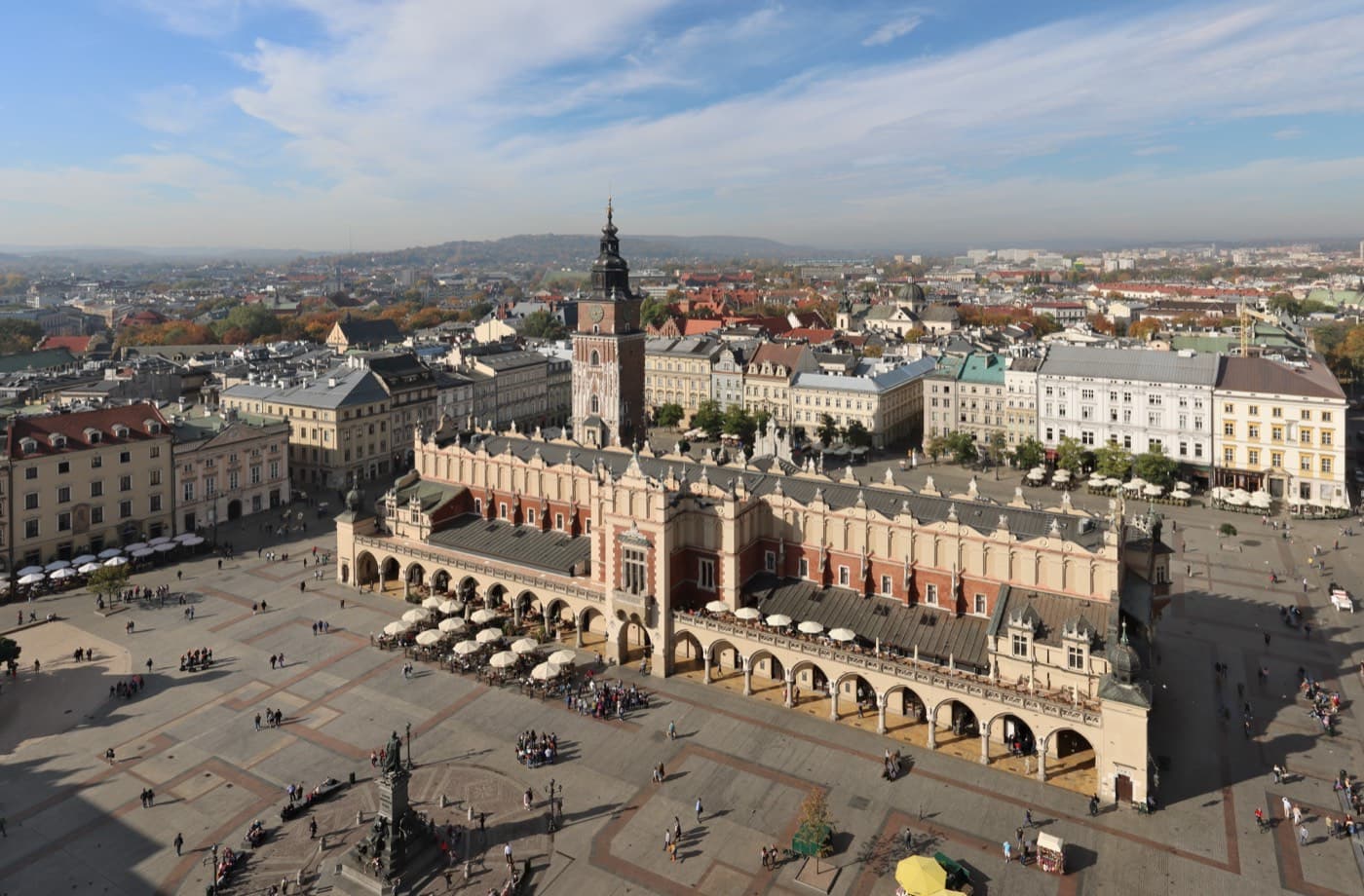
Kraków was Poland's historic royal capital until the 17th century, and unlike Warsaw, its medieval Old Town survived the Second World War largely undamaged — genuinely walkable, dense with real (not reconstructed) Gothic and Renaissance architecture, anchored by one of Europe's largest medieval town squares.
Quick facts
Old Town and Wawel Castle
Rynek Główny, Kraków's main square, is one of the largest medieval town squares in Europe, ringed by the Cloth Hall (a Renaissance trading hall now full of stalls) and St. Mary's Basilica, whose hourly trumpet call (the hejnał) is a genuine centuries-old tradition, not a tourist performance. Wawel Castle and Cathedral, former seat of Polish kings, sit on a hill just south of Old Town — the cathedral crypts hold the tombs of Polish monarchs and national heroes.
Kazimierz
Kazimierz, Kraków's historic Jewish quarter, has a genuinely different atmosphere than the polished Old Town — synagogues (several still active), a somber Jewish cemetery, and in recent decades a real revival as a nightlife and creative district, with bars and galleries occupying buildings alongside preserved religious sites. Schindler's Factory, now a museum on Kraków under Nazi occupation, sits nearby in the neighboring Podgórze district.
Auschwitz-Birkenau
The Auschwitz-Birkenau memorial and museum, about 1.5 hours from Kraków, is one of the most visited and important historical sites in Europe — sobering, essential, and genuinely different from a typical day-trip attraction. Book tickets well in advance (they're timed and frequently sell out), and budget at least half a day given the site's scale and the weight of what it asks visitors to take in.
Practical tips
- —Book Auschwitz-Birkenau tickets online well ahead — timed entry slots fill up, especially in summer, and walking up without a reservation risks not getting in at all.
- —Rynek Główny's hejnał trumpet call plays every hour from St. Mary's tower — worth timing a visit to hear it, and worth knowing it commemorates a real historical event (a trumpeter shot mid-call during a 13th-century invasion), not just tradition for its own sake.
- —Kazimierz rewards an evening visit as much as a daytime one — the bar and restaurant scene there is genuinely one of Kraków's best, distinct from Old Town's more tourist-oriented options.
- —Kraków connects to Warsaw by a fast, frequent train (around 2–2.5 hours) — a realistic two-city Poland trip without needing a car.